Prepared Foods, Soups & Culinary Bases
Formulation, texture and stability in prepared foods and culinary bases
A liquid soup, a multi-component ready meal, shakshuka and an instant powder mix are different systems: they differ in water content, particulates, heat treatment and how the consumer prepares them.
We develop and improve products by considering ingredients, cooking, structure, packaging and the intended preservation method together — so flavour and texture hold in production, not only in the development kitchen.
Product families
Chilled, frozen, retorted and dry products need different decisions on composition, process and packaging, even when the dish looks similar.
- 01
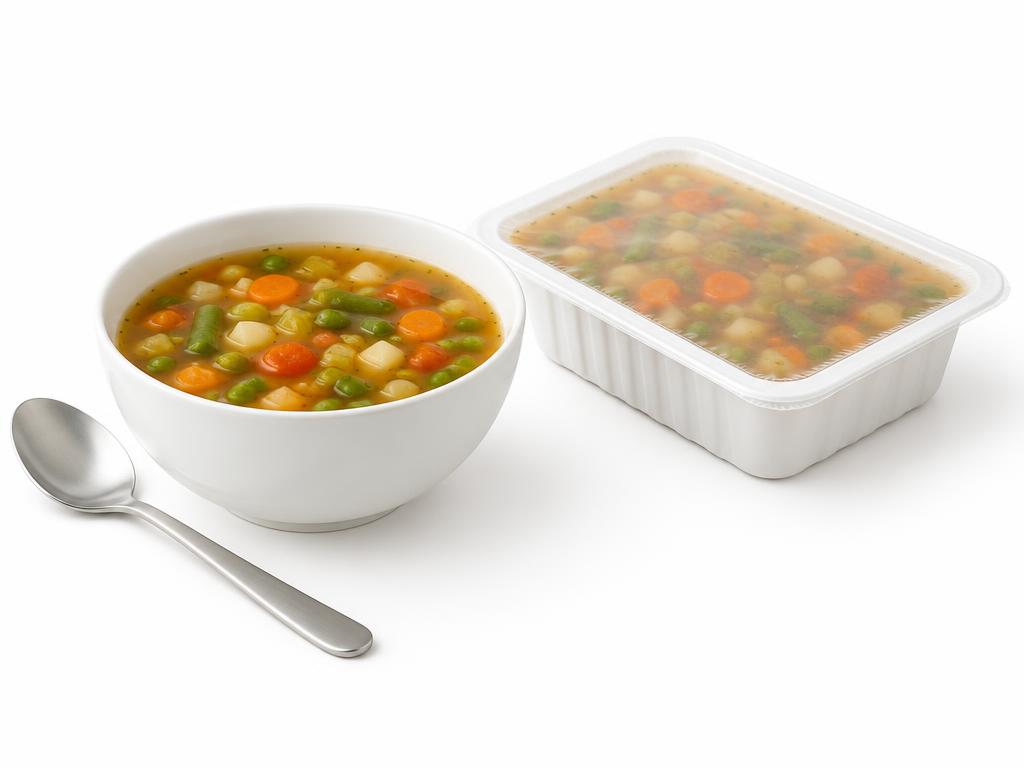
Liquid and cream soups
Vegetable, pulse, broth-based and creamy soups. Viscosity, starch and proteins, emulsion stability, particulates and texture change after heat treatment and reheating.
- 02
Instant soups
Dry soups and powders reconstituted with hot water. Dispersion and dissolution, lumping, rapid thickening, dried vegetables and seasonings, and moisture pick-up in the pack.
- 03
Shakshuka and tomato-based dishes
Shakshuka, vegetable bases and particulate stews. Acidity, tomato solids, water release, colour and flavour after cooking and preservation; the preservation strategy is set per product.
- 04
Ready meals
Dishes combining a main component, side and sauce. Moisture migration between components, carbohydrate and protein texture, freeze and reheat behaviour, and tray or pack suitability.
- 05
Ready-to-eat products
Chilled or shelf-stable products eaten without further cooking. Control of texture, colour and flavour through storage; safety and shelf life require product-specific validation.
- 06
Culinary bases
Stocks, pastes and concentrates for home or professional cooking. Solids concentration, salt, depth of flavour, pumpability and filling, and even dispersion in use.
- 07
Powdered culinary mixes and bases
Seasoning blends and powdered sauce or soup bases. Blend uniformity, particle segregation, powder flow, hygroscopicity and behaviour during preparation.
- 08
Plant-based, reduced-sodium and reformulated dishes
Plant-based, protein- or fibre-enriched and lower-sodium meals. Balancing flavour and texture without relying on a single ingredient; nutrition claims are assessed separately.
Technical challenges
We review the recipe, cooking sequence, heat treatment, packaging and consumer preparation together to identify where the product changes.
Soup too thick, too thin or different after reheating?
Check starch type and degree of gelatinisation, proteins and hydrocolloids, solids and shear, and the change after heat treatment, cooling and reheating — not just a single viscosity reading.
Ready-meal components turn soft or dry out?
Assess moisture migration between sauce, carbohydrate and protein, initial degree of cooking, fill ratios and packaging, and freezing or chilling and reheating conditions.
Soup powder forms lumps or won't dissolve?
Review particle size, blending order and method, hygroscopic ingredients, overly fast thickening and moisture content, alongside preparation instructions and moisture-protective packaging.
Flavour fades or shifts after preservation and storage?
Distinguish the effects of heat treatment, oxidation, packaging interactions and aroma change in storage. Review when seasonings are added and adapt the recipe to the process.
Sodium reduction weakens the flavour?
Treat salt, umami, acidity, herbs and aroma as one system and check effects on texture and processing, rather than swapping salt for a single ingredient.
Water release or separation in the finished dish?
Check the starch and hydrocolloid network, retrogradation under chilling, freeze–thaw behaviour and emulsion stability in the fat-containing parts of the dish.
Vegetable, pulse or protein pieces break down in processing?
Review cut size, pre-cooking, pumps and mixers, hold times and heat penetration to balance particle integrity against adequate thermal treatment.
The recipe works in the kitchen but not on the line?
Compare batch size, heating and cooling rates, evaporation, pump shear, filling and packaging, and translate the culinary recipe into parameters production can repeat.
Processes & technologies
Selection depends on the product, particulates, storage conditions and preparation. Chilling, freezing, retorting and drying are not automatic substitutes for one another.
- 01
Raw materials & pre-preparation
Selecting vegetables, pulses and protein sources; cutting, soaking and pre-cooking according to their role in each dish.
- 02
Cooking, flavour & thickening
Cooking and reduction, flavour development, thickening with starches and hydrocolloids, and rheology control before filling.
- 03
Mixing, emulsions & meal assembly
Combining sauce and particulates, homogenisation where needed, filling separate components and assembling meals.
- 04
Heat treatment & preservation
Pasteurisation, hot fill, retort, chilling or freezing — only after professional validation matched to the recipe and pack.
- 05
Powder blending & drying
Dry blending, mix uniformity, agglomeration and dried ingredients for instant products.
- 06
Packaging, storage & scale-up
Pack selection, cold chain where needed, preparation instructions, and planning and assessment of pilot and scale-up trials.
From lab to production
Cooking in a development-kitchen pot differs from an industrial kettle: heating times, evaporation, shear and particle integrity change, and so do flavour and texture. We review recipe, ingredients, equipment and process parameters together and prepare trials with manufacturing partners.
Microbiological safety, the preservation process, packaging and shelf life require product-specific validation, with appropriately qualified specialists when needed.
Developing a soup, ready meal or culinary base, or solving a production problem?
Tell us briefly about the product and your texture, flavour, preservation or processing challenge.
Tell us about your product