Sauces, Dressings, Dips & Savoury Spreads
Formulation, texture and stability in sauces and savoury spreads
Each sauce matrix behaves differently: oil-in-water emulsions, aqueous tomato systems, acidic dressings, pulse purées and high-solid spreads demand distinct approaches to texture, physical stability and safe processing.
We develop and improve products by considering ingredients, structure, manufacturing conditions and intended packaging and preservation together, rather than assuming one process suits every sauce.
Product families
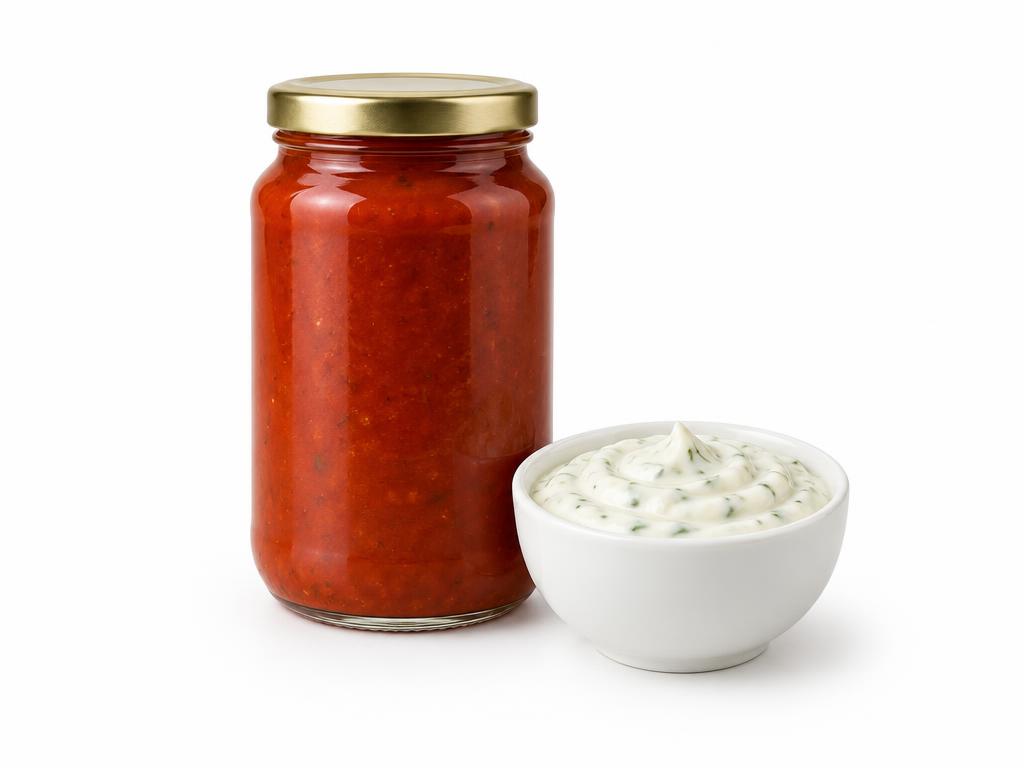
Emulsions, tomato systems and pulse dips differ in structure and preservation needs. Acidic tomato sauces and low-acid hummus require separate safety strategies.
- 01
Mayonnaise & emulsified sauces
Mayonnaise, egg-based or egg-free creamy emulsions and aioli-type systems. Droplet size, emulsifier, oil load, viscosity, texture and stability during manufacturing.
- 02
Pourable salad dressings
Vinaigrettes, oil–water suspensions, flavoured and creamy dressings. Phase behaviour, vinegar and acid, suspension, pourability, flavour and oxidation.
- 03
Tomato sauces & cooked bases
Pasta sauces, shakshuka bases and cooking sauces. Acidity profile, tomato solids, vegetables, particulates and heat compatibility; acidification and hot fill are not universal solutions.
- 04
Hummus, tahini & pulse dips
Hummus, tahini-based dips and bean spreads. Hydration, particle size, fat–water interactions and separation. Microbiological constraints, refrigeration and process-dependent shelf life need validation.
- 05
Vegetable & herb dips and spreads
Pepper, eggplant and pesto-style systems. Water release, oxidation and discolouration, oil emulsions and particulate structure, matched to the preservation strategy.
- 06
Sweet–savoury & condiment sauces
BBQ-, chilli- and ketchup-style systems and concentrated condiments. Soluble solids (Brix), salt, acids, viscosity, flavour and heat stability, not solely heat or spice.
- 07
Low-fat, egg-free & reformulated sauces
Plant-based and nutrition-adjusted systems. Proteins, fibres and alternative stabilisers balance body, droplets, mouthfeel, flavour and cost; claims are verified separately.
- 08
Industrial bases & particulate sauces
Bulk foodservice sauces, concentrates, premixes and bases. Distribution, fillability, settling, heat penetration and equilibrium; jars, pouches and bulk packs suited to a validated process.
Technical challenges
Investigate the mechanism behind separation, flow or processing changes alongside the product's preservation and safety strategy.
Does the emulsion break or form an oil layer?
Review the oil and emulsifier system, droplet distribution, ingredient addition, mixing and shear, alongside salt, pH and changes during processing and storage.
Does the sauce release water, settle or lose uniformity?
Check hydrocolloid and starch networks, suspended solids and particles, hydration, thermal shear and storage behaviour to distinguish water release from settling and incomplete dispersion.
Too thick to pump or too thin to serve?
Map shear-dependent rheology and yield stress at operating temperatures, then assess pumps, fill conditions and packaging against the flow required in production and at serving.
Does heat treatment change texture, colour or flavour?
Review starch, protein and hydrocolloid systems, acidity changes, time and heat, oxidation and consistency before and after treatment to distinguish formulation effects from processing effects.
Does fat reduction or egg replacement lose creaminess?
Assess the emulsion and stabilising matrix together: proteins, fibres, droplet structure, mouthfeel and processing sequence, rather than seeking one substitute for every ingredient function.
Does a vegetable dip separate, oxidise or deteriorate?
Distinguish water–fat separation, enzymatic oxidation and spoilage. Review ingredient variability and pH, with realistic microbiological validation and appropriate preservation or refrigeration; appearance does not establish safety.
Does a particulate sauce need extended preservation?
Assess particle size, equilibrium pH, heat transfer and pack suitability with a qualified process authority establishing a validated scheduled process; acidity or hot fill alone cannot assure ambient storage.
Works in the lab but fails during filling or production?
Compare mixing scale, hold times, pump shear, heating and cooling, fill conditions and package geometry to identify where product structure changes on the production line.
Processes & technologies
Selection depends on the matrix, particulates, packaging and storage conditions. Acidification, heat treatment and refrigeration are not automatically interchangeable.
- 01
Raw-material preparation & hydration
Prepare and cook vegetables and particulates where relevant; hydrate and disperse ingredients according to the system.
- 02
Emulsification & oil incorporation
High shear, homogenisation and oil addition suited to the recipe and equipment, with attention to droplet structure.
- 03
Thickening, rheology & filling
Starch gelatinisation, hydrocolloids and particle size; adapt flow behaviour for pumping and filling.
- 04
Acidification & safety strategy
Salt, soluble solids and equilibrium pH. Distinguish acidified from low-acid foods and validate for the particular matrix and pack.
- 05
Product-specific heat treatment
Pasteurisation, hot fill, retort or another suitable process only after professional validation at an appropriate facility for the recipe and container; pack heat resistance is not assumed.
- 06
Cooling, packaging & scale-up
Jars, pouches and bulk packs, product holds and cold chain where needed; planning and assessment of scale-up trials.
From lab to production
Thick sauces, emulsions and particulate products change under larger mixing, pumping, heating and packaging conditions. We investigate formulation, ingredient interactions, thermal profile and equipment capabilities together, then prepare and support pilots with manufacturers according to the project.
Microbiological safety, process lethality, packaging and shelf life require specific technical validation, with coordination of appropriately qualified specialists when needed.
Developing a sauce, dip or spread, or resolving a stability or manufacturing problem?
Tell us briefly about the product and your texture, preservation or processing challenge.
Contact us