Snacks, Breakfast Cereals & Extruded Products
Formulation, texture and adaptation to extrusion processes
For extruded snacks, product quality depends on raw material composition as much as the extrusion process. Starch, proteins, fibers, moisture, temperature, shear and die geometry jointly influence expansion, cell structure and crispness.
We evaluate formulation and process together, from prototype to pilot and industrial adaptation, with the specific ingredients and equipment in view.
Product families
Direct expansion, secondary expansion and cereal inclusions need different matrices and processes. Non-extruded baked snacks and high-moisture structured meat alternatives belong to separate fields.
- 01
Direct-expanded cereal snacks & puffs
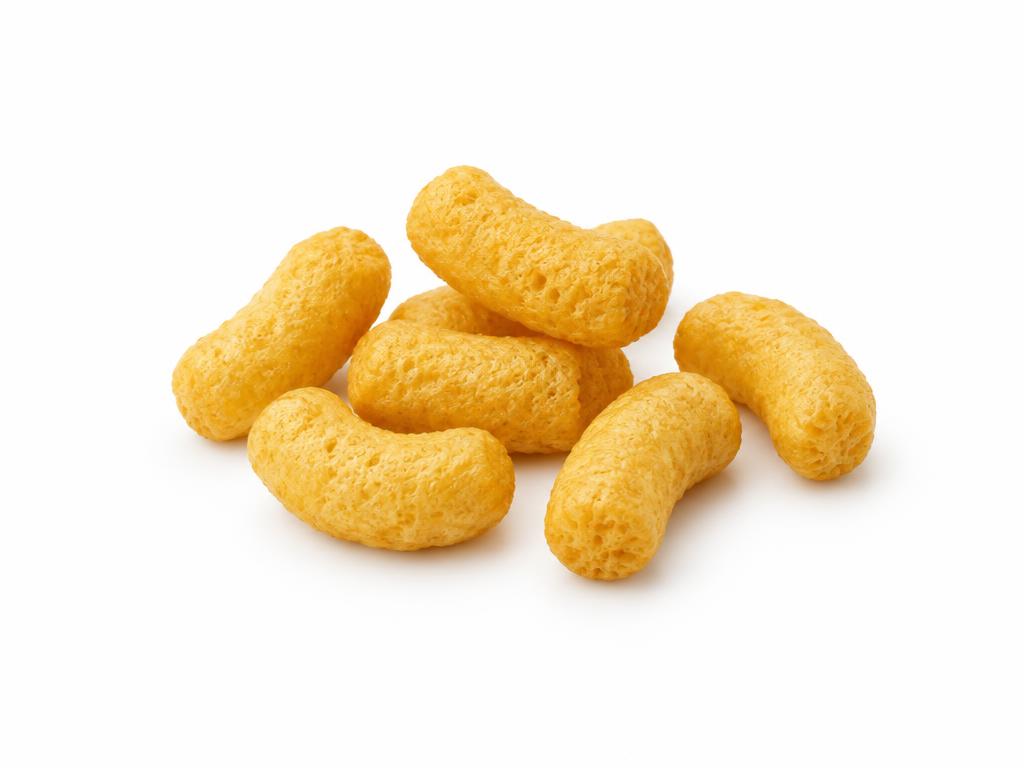
Corn- and rice-based sticks, rings and other shapes. Starch gelatinization, expansion, cell structure, bulk density and crispness.
- 02
Pulse- & legume-based snacks
Peas, chickpeas, lentils and blends. Starch–protein–fiber interactions, hydration and their effects on reduced expansion, off-notes and texture.
- 03
Protein-enriched & functional snack matrices
Cereal–protein blends, high-protein crisps and enriched snacks. Protein functionality, extrusion response, density and mouthfeel; nutrition claims require verification.
- 04
Extruded breakfast cereals
Flakes, loops, balls and ready-to-eat cereal pieces. Expansion, strength, controlled crispness and behavior with milk.
- 05
Multigrain & alternative-grain snacks
Rice, corn, sorghum, pseudo-cereals and alternative flours. Raw-material variability, water binding and matrix properties; gluten-free status requires verification.
- 06
Pellets & secondary-expanded snacks
Extruded semi-products expanded later by suitable frying or hot-air processes. Form stability and finished density, distinct from direct expansion.
- 07
Seasoned or coated snacks
Oil and seasoning adhesion, coating evenness, lipid uptake, hygroscopicity and crispness in storage. Downstream coatings must suit the line: not every coating is possible on every machine.
- 08
Extruded cereal crisps & inclusions
Crisp pieces for bars, toppings, granola and clusters. Size, strength, moisture uptake and compatibility with the composite food matrix.
Technical challenges
Diagnostic direction comes from ingredient, process and equipment interactions, not a single setting.
Does the snack expand poorly and stay hard or too dense?
Review available starch, added protein, fiber and fat, and feed moisture alongside specific mechanical energy (SME), temperature, screw and die. No single adjustment applies to every system.
Does the product break or have an irregular structure?
Check bubble formation, pore and cell distribution, shear, die, cutter and drying to identify where the structure changes.
Do legumes or protein alter expansion, flavor or texture?
Assess hydration, particle size, composition and processing conditions. Review off-flavors and options for blending with other ingredients.
Does a different flour lot change extrusion behavior?
Compare moisture, starch fraction and damage, particle-size distribution, protein and fiber, then assess process corrections for the measured variability.
Is extruder pressure, torque or flow unstable?
Check feed rate, mixing, hydration, temperature profile and material rheology while monitoring pressure and SME. Review screw and die configurations compatible with the plant's equipment.
Does the snack lose crispness during storage?
Assess residual moisture and water activity, the packaging's water-vapor barrier, hygroscopic seasonings and coatings, and product handling.
Does seasoning fail to adhere or distribute evenly?
Review surface properties, oil application, temperature and seasoning particle size alongside drum operation and distribution.
Does a pilot formulation fail on another extruder?
Compare equipment geometry, screw configuration, energy, residence time, die, throughput and downstream drying. Adaptation needs trials on the specific machine.
Processes & technologies
Distinguish controlled inputs such as feed moisture and temperature, monitored states such as pressure and SME, and resulting expansion, density and texture. Their relationships depend on the material and machine.
- 01
Raw materials & preblends
Flour milling, particle size, starch, protein and fiber composition, and preparation of preblends.
- 02
Blend conditioning & feed
Mixing, water conditioning and controlled feed rate and moisture suited to the matrix and equipment.
- 03
Thermal–mechanical extrusion
Review temperature, screw speed and shear, monitor SME and pressure, and assess residence time and die geometry.
- 04
Expansion, shaping & cutting
Adapt die discharge and cutting to the product's required structure, shape and density.
- 05
Drying & secondary expansion
Drying, toasting or secondary expansion as appropriate, and evaluation of post-extrusion texture.
- 06
Seasoning, packaging & pilot transfer
Coating, seasoning, cooling, moisture control, packaging adaptation and trial planning with downstream line steps.
From lab through pilot to production
Changing extruder design, screw, die, scale or feed can affect expansion and texture even when ingredient percentages remain unchanged. We connect formulation work with the specific process and downstream steps.
Work includes technical trial plans, assessment of results and support for pilot or factory trials as agreed. Food safety, labeling and shelf life require product-specific validation.
Developing an extruded snack or cereal, or solving a process problem?
Tell us briefly about the product and your formulation, texture or manufacturing challenge.
Contact us