Food Reformulation: Why Replacing One Ingredient Can Change the Entire Product
Two ingredients may look similar on a technical specification sheet yet behave very differently in a food product. Through examples from sauces, ice cream and protein beverages, we explore what matters when replacing an ingredient.
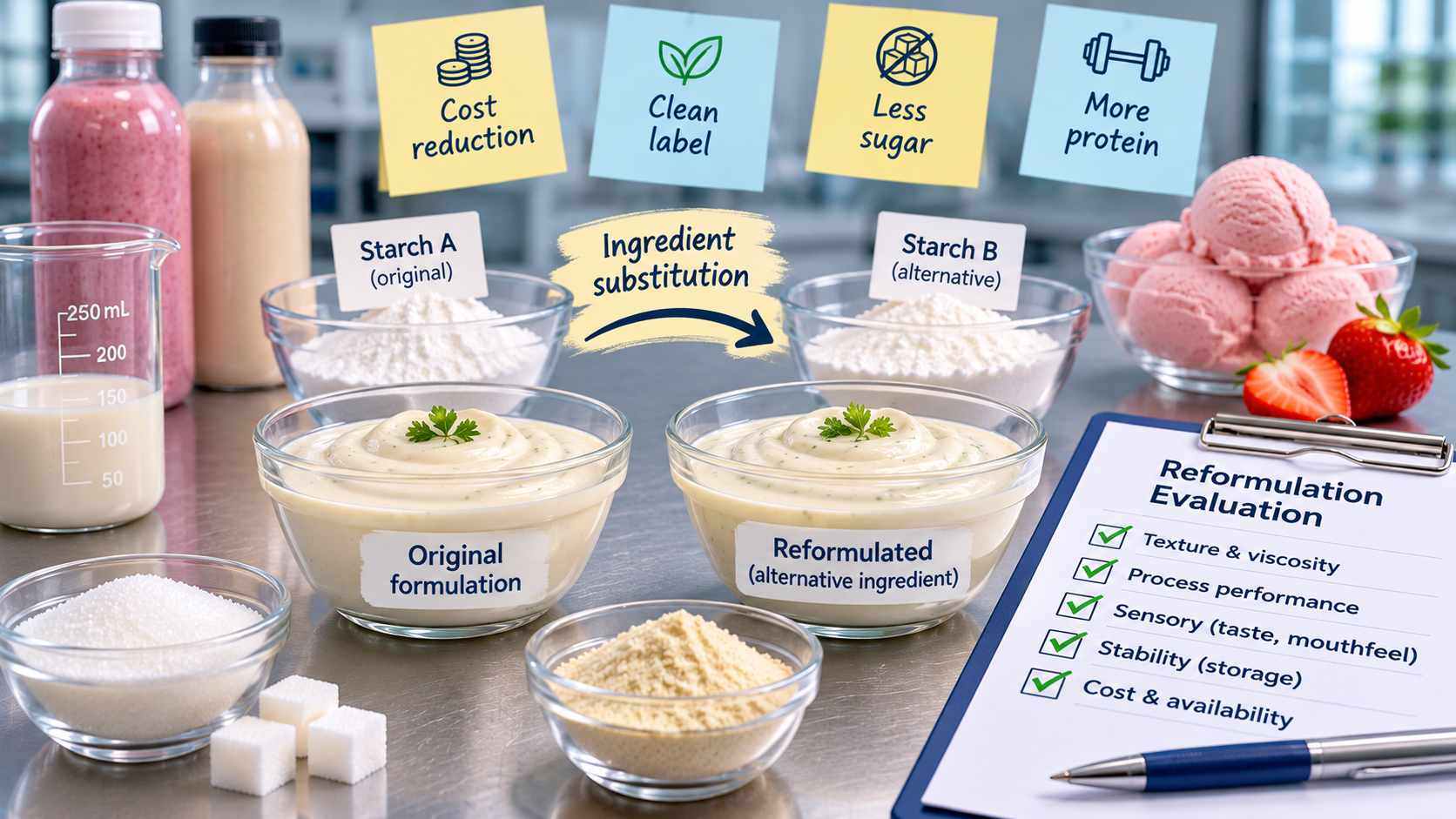
Imagine a food company producing a successful sauce. The formulation is well established, the texture is right, the manufacturing process is defined, and customers are happy with the product.
One day, the supplier announces that one of the starches used in the recipe will no longer be available.
The company finds an alternative. According to the technical specification, it looks suitable, the price is reasonable, and an initial laboratory trial produces a good result.
The new starch is introduced at the same dosage, and production continues.
But problems begin to appear on the manufacturing line. The sauce has a different viscosity, it no longer flows through the filling equipment in quite the same way, and the final texture has changed.
How can this happen when all we did was replace one starch with another?
This is a common challenge in food product development and reformulation. Two ingredients may look almost identical on paper yet behave very differently once they become part of a food system.
Replacing an ingredient is not always as straightforward as removing one component and adding another. To do it properly, we need to understand what the original ingredient contributes to the formulation, how it interacts with other components, and how it behaves during processing.
Why Do Companies Reformulate Existing Food Products?
Reformulation does not always begin with a quality problem.
Sometimes the objective is to reduce costs. In other cases, a company may want to improve the nutritional profile, deal with an ingredient shortage, change suppliers or meet new market requirements.
A manufacturer might want to develop a no-added-sugar version of an existing product, increase its protein content, simplify the ingredient list or replace a raw material that is no longer commercially practical.
In some projects, a different final product is expected.
In others, the goal is exactly the opposite: make the change without consumers noticing any difference.
That is often the more demanding challenge.
If we want to preserve the original flavor, texture, appearance and storage stability, the replacement needs to perform the functions that the original ingredient provided.
And sometimes we discover that the original ingredient was doing much more than we realized.

Similar Specifications Do Not Guarantee Similar Performance
When evaluating an alternative raw material, comparing technical specifications is an obvious starting point.
Depending on the ingredient, we might examine protein content, moisture, fat, purity, particle size or viscosity.
This information is important, but it does not tell the whole story.
For example, two ingredients with the same protein content may differ significantly in solubility, water-binding capacity, emulsifying properties or heat stability.
Two starches might develop similar viscosity under one set of laboratory conditions but behave differently when exposed to heating, intensive mixing or acidic environments.
Even ingredients with similar chemical compositions can perform differently because of differences in particle size, physical structure or processing history.
The key question, therefore, is not simply whether the new ingredient resembles the original.
It is whether it can deliver the same functional performance within the product and under the actual manufacturing conditions.
Three examples help illustrate why this distinction matters.
Three Examples Where an Ingredient Replacement Changes More Than Expected
1. Replacing a Starch in a Sauce
Let's return to the sauce from the beginning of the article.
Starch can contribute to viscosity, texture and water retention. However, not all starches behave in the same way.
Their botanical origin, molecular structure and any modifications they have undergone can influence gelatinization, viscosity development and resistance to different processing conditions.
One starch may develop high viscosity during heating but lose part of it when exposed to intensive mixing or mechanical shear.
Another may offer better processing resistance while producing a different texture after cooling.
The acidity of the sauce can also influence the performance of the starch system.
Suppose we select an alternative based only on a simple viscosity measurement carried out in the laboratory.
The initial result might look excellent, but when the sauce goes through the complete manufacturing process, its behavior may change.
In this situation, asking how much starch to add is not enough.
We need to understand when and how viscosity develops, how the starch responds to heating and shear, and what happens to the texture after cooling.
It may also be necessary to adjust the ingredient addition method, hydration conditions or processing steps.
The most suitable starch is not necessarily the one that produces the highest viscosity.
It is the one that delivers the required performance throughout manufacturing and in the finished product.
2. Reducing Sugar in Ice Cream
Sugar is an excellent example of an ingredient that performs several functions at once.
When a company wants to develop an ice cream with less sugar, the first question is often how to maintain the desired sweetness.
High-intensity sweeteners can help achieve similar sweetness using very small quantities.
But sugar does much more than make ice cream taste sweet.
It also contributes to total solids and influences the freezing behavior of the mixture.
In ice cream, the type and concentration of sugars affect the amount of water that remains unfrozen at a given temperature. This has a direct influence on hardness and texture.
If we remove a significant amount of sucrose and replace its sweetness using only a high-intensity sweetener, we have not restored those other functions.
The result may be a harder ice cream with a texture that differs from the original product.
Replacing sucrose with an equal weight of another ingredient does not automatically solve the problem either.
Different sugars and bulking agents can have different effects on freezing point depression, viscosity and other properties of the ice cream mix.
A successful reduced-sugar formulation therefore requires us to consider several parameters together: sweetness, total solids, the composition of the aqueous phase, freezing behavior, texture and processing conditions.
The goal is not simply to find something that tastes as sweet as sugar.
It is to rebuild the functional balance of the formulation.
3. Replacing a Protein in a Beverage
Now imagine a company looking to replace the protein used in one of its beverages.
The new ingredient has a similar protein content, offers an attractive price and allows the product to maintain the same amount of protein per serving.
From a nutritional perspective, the substitution may appear straightforward.
But protein content alone tells us very little about how the ingredient will behave in the beverage.
Solubility, hydration and protein interactions are influenced by factors such as protein source, previous processing, pH, formulation composition and manufacturing conditions.
One protein may disperse well in water but create problems when incorporated into a more complex formulation.
Another might perform well at room temperature but change its behavior during heat treatment.
Under certain conditions, these changes can lead to protein aggregation, increased viscosity, sedimentation or gel formation.
This is why comparing the protein percentages listed on technical specifications is not enough.
We need to understand how the protein hydrates, how it responds to pH and temperature, and how it behaves within the complete formulation.
Sometimes the solution also requires adjustments to the manufacturing process, such as ingredient addition order, hydration time, mixing conditions, homogenization or heat treatment.
Two ingredients may deliver nearly identical amounts of protein while requiring very different formulation and processing strategies.
How Should an Ingredient Replacement Be Approached?
There is no universal method that applies to every food product. However, a structured approach can help reduce mistakes and avoid unnecessary trials.
Start by Defining What Needs to Change and What Must Stay the Same
Before selecting alternative ingredients, we need to establish the objective of the reformulation.
Are we trying to reduce costs? Remove a particular ingredient? Improve the nutritional profile? Resolve a supply issue?
Next, we need to define which product characteristics must be preserved.
These may include flavor, texture, appearance, processing performance, stability, nutritional composition or labeling requirements.
Not every parameter carries the same importance in every product.
For a beverage, viscosity and physical stability may be critical. For a cookie, spread during baking, internal structure and final texture might be more relevant.
Establishing these requirements before starting allows us to compare alternatives against clear criteria rather than relying only on a promising first tasting.
Understand the Role of the Original Ingredient
This is one of the most important stages.
We need to identify what the original ingredient contributes to the formulation and how it behaves during processing.
Some ingredients influence structure, viscosity, emulsification, water binding, foaming or thermal behavior.
Others contribute to flavor, color or nutritional composition.
We also need to consider interactions with the other ingredients.
It is not unusual to discover that a raw material originally selected for one main purpose also contributes to several other product characteristics.
When that ingredient is removed, those contributions may disappear or change.
This explains why a successful replacement sometimes requires a combination of ingredients or adjustments elsewhere in the formulation.
Compare Alternatives Through Controlled Trials
Once the relevant functions have been identified, we can select possible replacements and design appropriate experiments.
It is important to retain the original formulation as a reference and compare the new versions under defined conditions.
Depending on the product, measurements might include viscosity, pH, water activity, instrumental texture, physical stability, thermal behavior or sensory properties.
Not every project needs every test. The measurements should be selected according to the characteristics we want to preserve and the technical risks associated with the change.
Sample preparation also matters.
If we change the ingredient, its concentration, the mixing process and the temperature in the same experiment, it may be difficult to determine which variable caused an improvement or a problem.
Controlled comparisons make the results easier to interpret and help us make decisions based on evidence rather than a trial that simply appears successful.
Confirm That the Solution Works in Manufacturing
A formulation that performs well in a small laboratory batch will not necessarily behave the same way on an industrial production line.
Mixing, heating, cooling, homogenization and product transfer conditions may differ significantly.
This is particularly important when the ingredient being replaced affects product structure or is sensitive to processing conditions.
In some cases, targeted verification using existing equipment may be sufficient. In others, pilot trials or industrial production tests may be necessary.
The extent of testing should reflect the significance of the change and the risks involved.
The objective is not to turn every ingredient substitution into a complicated development project.
It is to make sure that the selected solution works under the conditions in which the product will actually be manufactured.
A Cheaper Ingredient Does Not Always Mean a Cheaper Product
Reducing raw material costs is one of the most common reasons for reformulation.
But comparing ingredients based only on price per kilogram can lead to the wrong decision.
A less expensive ingredient may require a higher dosage to achieve the same result.
It might also require different processing conditions, increase production time or lead to greater losses if its performance is less consistent.
For this reason, we should evaluate not only the purchase price but also the actual amount required and the ingredient's effect on total manufacturing costs.
Availability is another important factor.
A raw material may perform extremely well from a technical perspective but still be unsuitable commercially if its supply is unreliable or it does not meet the requirements of the intended market.
In industrial food reformulation, the solution needs to make sense both technically and economically.
Is It Always Possible to Replace an Ingredient Without Changing the Product?
Not necessarily.
Some substitutions can be achieved with relatively minor adjustments. Others require substantial changes to the formulation or manufacturing process.
There are also situations where reproducing exactly the same product is not realistic, particularly when the original ingredient provides several functions that are difficult to replicate.
In these cases, it helps to identify which characteristics are essential and where some flexibility is acceptable.
The solution might involve combining several ingredients, modifying the process or accepting a slightly different characteristic that is still suitable for the intended product.
What matters is making these decisions deliberately rather than discovering their consequences after the product has already entered production.
Reformulation Does Not Mean Starting From Scratch
An established formulation represents a considerable amount of accumulated work and knowledge.
We already know its characteristics, we have a reference for comparison and, in many cases, we understand how it behaves during manufacturing.
That knowledge is valuable.
The goal of reformulation should not be to change everything. It should be to identify what needs to change while preserving what already works.
Achieving that requires understanding ingredient functionality, designing meaningful comparisons and confirming that the final result performs under real manufacturing conditions.
At NICO Food Innovation, we approach food product development and reformulation by considering the relationship between raw materials, formulation and processing technology. This applies both to developing new products and improving existing ones.
Because replacing an ingredient on paper can be the easy part.
The real challenge is making sure the product continues to perform as intended.