Snack Extrusion: Why the Same Formula Can Produce Different Textures
Two batches made with the same formula can differ in expansion, density and crunch. We explore how raw materials, moisture, extrusion conditions and downstream processing shape the final snack.
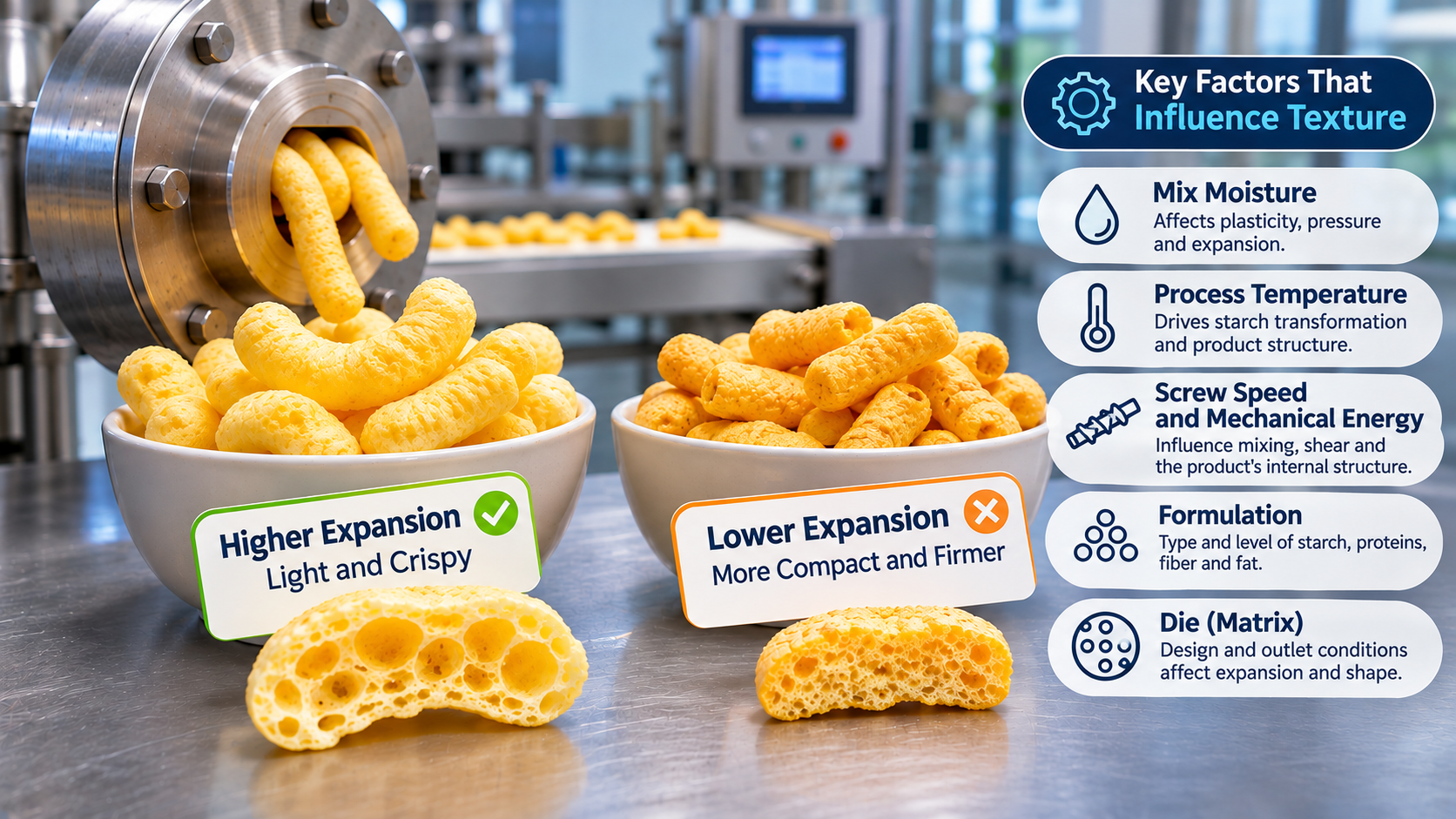
A company is producing an extruded snack with a light, crispy texture and the right level of expansion. The formulation has been established, the product has the desired shape, and the first production runs are successful.
Then, during another production run, something changes.
The snack comes out denser, expands less and feels harder when you bite into it.
The recipe is the same. The ingredient quantities have not changed, and the extruder appears to be running at the same settings.
So why is the result different?
In food extrusion, using the same formulation does not guarantee the same product structure every time. Changes in raw material moisture, processing conditions, mechanical energy and the behavior of the material as it leaves the die can all affect the final texture.
Understanding these relationships is essential when developing new snacks, improving existing products or troubleshooting inconsistent production.
What Makes an Extruded Snack Expand?
To understand why texture changes, it helps to look at what happens inside the extruder.
In the production of directly expanded snacks, a mixture typically containing starch-rich ingredients is fed into the extruder along with a controlled amount of water.
As the material moves through the barrel, it is exposed to heat and mechanical work generated by the screw or screws.
The combination of temperature, moisture, pressure and shear causes physical and structural changes in the ingredients, particularly the starch.
Under suitable conditions, the material develops into a hot, viscous mass that can flow through the die at the end of the extruder.
When the material exits the die, the pressure drops rapidly. Some of the water flashes into steam, creating and expanding bubbles within the product.
As the extrudate cools and loses moisture, the developing structure begins to set.
The result is a porous structure made up of air cells and the solid walls surrounding them. This internal structure strongly influences the snack's density, hardness and crispness.
But there is an important detail.
Expansion is not determined simply by how much steam is generated.
The material must also have the right properties to allow bubbles to grow while maintaining the structure being formed.
If the mass is too resistant to deformation, expansion may be limited. If it cannot support the growing bubbles, cell walls may rupture or collapse before the structure has set.
This is why two formulations with apparently similar compositions can produce snacks with very different internal structures.
This article focuses on directly expanded extruded snacks. Products manufactured as pellets and subsequently expanded through frying, baking or other processes behave differently and should not be evaluated using exactly the same assumptions.
Moisture: One of the Most Important and Most Misunderstood Variables
When a snack shows poor expansion, moisture is often one of the first parameters to investigate.
And for good reason.
Water influences starch transformation, the viscosity of the material and how it flows and is processed inside the extruder.
It also provides the steam that contributes to expansion at the die exit.
However, the relationship between moisture and expansion is more complex than the common assumption that less water always means more expansion.
In some formulations, excessive moisture reduces melt viscosity and changes the pressure and mechanical work developed inside the extruder. Under those conditions, expansion may decrease and the snack may become denser.
But reducing moisture is not always the solution.
If the mixture contains too little water, material transport may become more difficult, mechanical loads may increase excessively, or the available processing conditions may be insufficient for the desired transformation of the starch.
The relationship can also be nonlinear.
In some systems, a small increase in moisture improves expansion up to a certain operating range. Beyond that range, adding more water may produce the opposite effect.
There is therefore no single moisture content that works for every extruded snack.
The appropriate range depends on the formulation, the equipment and the other processing conditions.
The Same Water Addition Does Not Always Mean the Same Moisture Content
This is an important point that can easily be overlooked during production.
Imagine a company using a corn-grit-based mixture. The recipe specifies a fixed amount of water to add before extrusion.
However, the incoming corn grits may have different moisture contents depending on the supplier, production batch or storage conditions.
Even when exactly the same amount of water is added, the total moisture content of the mixture may not be identical.
Particle size distribution, mixing efficiency and moisture distribution during preconditioning can also vary.
In other words, two batches prepared according to the same nominal recipe may enter the extruder in different conditions.
Before changing the machine settings, it is worth checking what material is actually entering the process.
Temperature and Screw Speed: More Is Not Always Better
Temperature plays a major role in starch transformation and in determining the properties of the material during extrusion.
Under certain conditions, increasing processing temperature can promote the required transformations and improve expansion.
But this is not always the case.
Excessive thermomechanical treatment can cause substantial degradation of starch molecules, changing the material's flow behavior and its ability to form a stable expanded structure.
It is also important to distinguish between the temperatures programmed into the extruder's heating zones and the temperature actually reached by the product.
The material receives energy from the barrel heating system, but also from the mechanical work applied by the screws.
As a result, two production runs with identical temperature setpoints may operate under different internal conditions if moisture, feed rate or mechanical load changes.
What Happens When Screw Speed Changes?
Screw speed can affect material transport, mixing, residence time, shear and the mechanical energy transferred to the product.
However, increasing screw speed does not necessarily increase expansion.
The outcome depends on screw configuration, feed rate, the degree of barrel filling and the properties of the material.
In some cases, a higher screw speed may improve expansion. In others, the change may affect pressure, residence time or processing intensity in a way that produces an undesirable result.
This is also one reason why copying the same screw speed and temperature settings between two different extruders does not guarantee an identical snack.
What matters is not simply what appears on the control panel.
It is what happens to the material as it passes through the equipment.
Why Specific Mechanical Energy Matters
One useful parameter when developing or optimizing an extrusion process is Specific Mechanical Energy, commonly referred to as SME.
In simple terms, SME represents the net mechanical energy transferred to the material per unit of mass processed.
It helps describe the mechanical intensity of the extrusion process.
Imagine two trials performed at the same screw speed.
In one trial, the motor operates at a higher load. In the other, the feed rate is different.
Although the screw speed is identical, the mechanical energy transferred per kilogram of product may be different.
SME can help reveal that difference.
However, a higher SME value is not automatically better.
Excessive mechanical treatment may change starch structure in ways that negatively affect the desired product characteristics.
Calculating and comparing SME also requires appropriate information about mechanical power, throughput and equipment characteristics.
For that reason, SME should not be treated as an isolated indicator.
It becomes more useful when evaluated alongside other measurements, such as actual melt temperature, pressure before the die, expansion ratio and product density.
Together, these parameters provide a clearer picture of what is happening during extrusion.
What Happens When We Add Protein, Fiber or Fat?
There is considerable interest in developing snacks with higher protein content, added fiber or alternative raw materials.
From a nutritional perspective, these changes may be attractive.
From an extrusion perspective, however, they can substantially alter the behavior of the mixture.
Protein
In a snack based primarily on starch, incorporating a significant amount of protein changes the relative proportions of the components responsible for forming the expanded structure.
Proteins can absorb water, undergo denaturation and interact with starch and other ingredients during processing.
Depending on their source, concentration and functional properties, these changes may affect melt viscosity, expansion, density and texture.
In some formulations, increasing protein content reduces expansion and produces a more compact structure.
But this is not a universal outcome.
Different proteins can behave very differently, and suitable processing conditions may allow some protein-enriched formulations to develop good expansion.
This is why developing a high-protein snack is not simply a matter of adding protein powder to an existing recipe while leaving all the extrusion settings unchanged.
The relationship between composition, moisture and processing conditions needs to be evaluated again.
Dietary Fiber
Adding fiber can also change expansion behavior.
Some fibers absorb water and alter its availability to other components. Others may interfere with starch structure formation or modify the flow properties of the material.
Their effects depend on factors such as fiber type, hydration capacity, particle size and inclusion level.
In certain formulations, high fiber concentrations can limit expansion and increase product density.
However, different fibers do not necessarily behave in the same way.
Each ingredient needs to be evaluated within the context of the complete formulation.
Fat
Fat can influence ingredient interactions and friction inside the extruder.
In some formulations, increasing fat content changes the mechanical energy transferred to the material and may reduce expansion.
This does not mean that adding fat is always detrimental.
Its effect depends on the concentration, how and when it is incorporated, and the properties of the other ingredients.
These interactions become particularly important when developing snacks with a modified nutritional profile while trying to preserve the texture consumers expect.
More Expansion Does Not Always Mean Better Texture
It is common to associate greater expansion with a lighter, crispier snack.
And often there is a relationship between the two.
But expansion alone does not determine eating quality.
The internal structure matters just as much.
Cell size, cell distribution, wall thickness and the mechanical properties of the material all influence what happens when the snack is bitten or broken.
Two snacks with similar densities can feel completely different in the mouth.
One may fracture easily and deliver a pleasant crispy sensation.
Another may be excessively fragile and break apart during packaging or transportation.
A third may feel harder when bitten, even though its expansion appears acceptable.
This is why evaluating texture should involve more than measuring the diameter of the extrudate.
We also need to understand its internal structure and how that structure fractures.
How Can We Measure These Differences?
Depending on the product and available equipment, useful measurements may include expansion ratio, bulk density, final moisture content and instrumental texture properties.
Mechanical fracture tests can provide information about the force required to break the snack and the way it responds to compression.
However, perceived crispness cannot be reduced to a single force measurement.
Fracture behavior, the number of breaking events during biting and, in some cases, the sound produced also contribute to the sensory experience.
For this reason, combining physical measurements with appropriate sensory evaluation can provide a more complete picture.
The goal is not necessarily to produce the snack with the highest possible expansion.
It is to achieve the structure and texture that best suit the intended product.
Texture Can Change After the Snack Leaves the Extruder
Another important point is that the manufacturing process does not end at the die exit.
Drying, cooling, coating and packaging can all influence the final texture.
For example, a snack may leave the extruder with adequate expansion but retain too much moisture after drying.
Its internal structure may be appropriate, yet the finished product may feel less crispy than expected.
In another situation, a snack may leave production with excellent crispness but lose it during storage because it absorbs moisture.
These are different problems.
Poor expansion is not the same as insufficient drying, and loss of crispness during storage is not necessarily related to the extrusion conditions.
If the product expands correctly at the die exit but the final texture is disappointing, changing the formulation or screw speed may not be the best place to start.
First, we need to determine where the problem actually develops.
How Should We Investigate an Expansion or Texture Problem?
Let's return to the example from the beginning.
We have two production runs using the same formulation. One produces a light, crispy snack. The other produces a denser and harder product.
The quickest reaction might be to increase temperature, reduce water or change screw speed.
But making adjustments before understanding the cause can make troubleshooting more difficult.
A better starting point is a structured comparison of the actual production conditions.
1. Check the Raw Materials and Mixture Preparation
Did the raw material supplier or production batch change?
Were there differences in initial moisture content or particle size?
Were mixing and preconditioning carried out in the same way?
It is important to verify the total moisture content of the mixture, not just the amount of water added according to the recipe.
2. Compare the Extrusion Conditions
Review feed rate, screw speed, motor load, processing temperatures and, where available, pressure before the die.
If SME can be calculated consistently, it may provide additional useful information.
Whenever possible, compare data collected after the process has reached stable operating conditions rather than relying on values recorded during start-up.
The condition of the equipment and die should also be checked.
Wear, partial blockages or changes in screw configuration can affect material behavior even when the formulation has not changed.
3. Compare the Products Using Objective Measurements
Measure expansion, density, moisture and texture.
Where possible, examine the internal structure of the snack as well.
These measurements can help determine whether the main problem is reduced expansion, a change in cell structure, excessive final moisture or a combination of factors.
4. Design Trials That Produce Useful Information
Once the most relevant variables have been identified, controlled trials can be planned.
Instead of changing water addition, temperature, screw speed and feed rate simultaneously, organize the experiments so that the effects of individual changes and their interactions can be interpreted.
In some situations, a focused series of trials with a clear reference will be sufficient.
In more complex cases, a structured experimental design can help evaluate several variables more efficiently.
The objective is not to run as many trials as possible.
It is to generate information that allows better decisions.
A Good Formulation Is Only Part of Successful Snack Extrusion
Extrusion offers considerable flexibility for developing expanded snacks, breakfast cereals, structured products and formulations enriched with different ingredients.
But that versatility comes with technical complexity.
When we change the formulation, we change the material entering the extruder.
When we change the operating conditions, we change how that material is transformed.
And when we modify the die, drying conditions or other downstream steps, we may change the shape, structure and texture of the finished product.
This is why developing an extruded snack should not end when we obtain one successful sample.
The real objective is to understand which conditions allow the product to be reproduced consistently and what operating range is suitable for the formulation and equipment.
At NICO Food Innovation, we approach extruded food product development by considering the relationship between raw materials, formulation, processing conditions and final product characteristics.
A good formulation is an important starting point.
The real challenge is turning that formulation into a snack with the desired texture and producing it consistently beyond the first successful trial.